
An abbreviated version of this essay first appeared in the Hardy Plant Society of Oregon‘s Quarterly. Thank you to their editors for input and improvements.
Your guests are arriving at six this evening to enjoy a home cooked meal. These are dear friends. You hope to offer them a memorable feast so they’ll return again. To gather ingredients for appetizer, entree, and dessert, do you wander the market aisles, adding to your cart whatever catches your eye? Or, do you plan the menu from your kitchen table, consulting recipes, peering into cupboards to see what you already have, and making shopping lists of ingredients and their quantities?
A delicious meal, even from the most experienced cook, requires planning. The same is true of a beautiful and ecologically rich garden.
The ingredients (or plants) you acquire need to compliment each other with balanced proportions and a well-rounded profile. Avoid the unsatisfying hodgepodge effect of random accumulation by composing a recipe beforehand. In garden design we call that recipe a designed plant community.
In this essay, I’ll take you through one example of a designed plant community. By sharing my process, I hope to inspire you to build your own community—one that is appropriate for your unique site and for your unique sense of beauty.

The Peaceful Retreat Garden
Thea Jaster and Mike Timmermann live surrounded by Oregon white oaks, Douglas fir, and Oregon ash trees in south Eugene. Their second story living room and kitchen look out on an upward sloping backyard. A previous owner had constructed an overly large, tiered deck over the space. Thea’s friend once stood on this deck and said, “Someone really hated nature.”
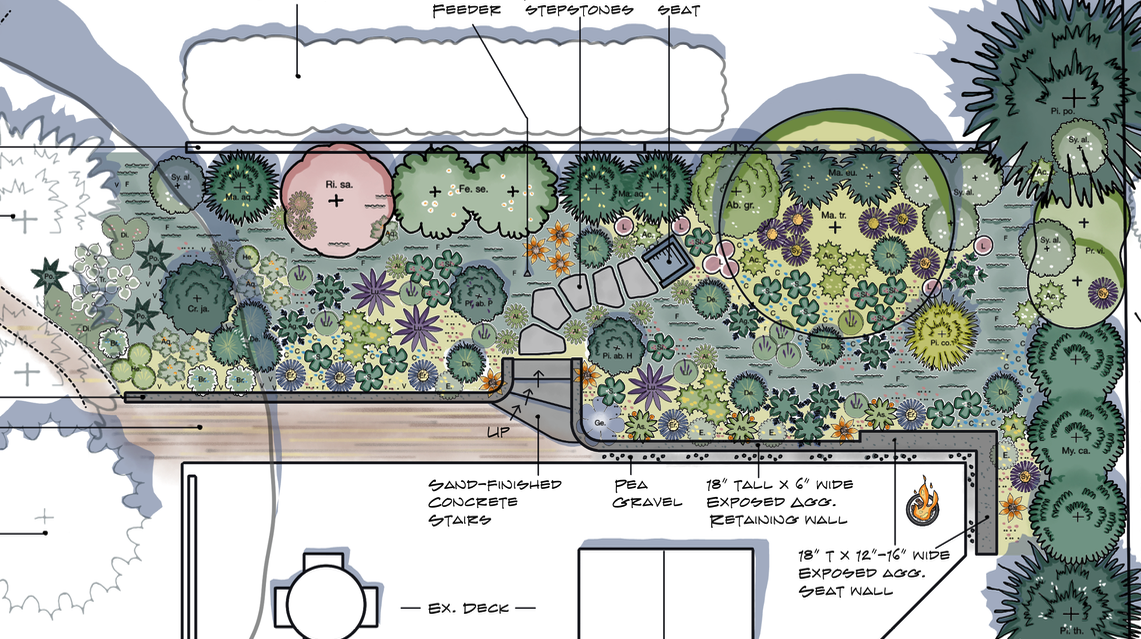
With most of the deck now gone, we resolved the challenge of the slope with a low retaining wall and stairs leading up to a solitary seat. I then turned my attention to designing the plant communities. I wanted the seat to feel immersed in the plantings and I wanted the view from inside to be fabulous.
First, I listened to the land. Crumbling lean soil between bare hands, walking the larger yard, noting what’s thriving (an epic Oregon white oak to the west) and what’s struggling (young Portuguese laurels), attending to the progress of sunlight and shade across the ground, the winds, the crow’s call—all this guides the choice of plants.
Second, I listen to the people. Thea is a botanist with a love of both native plants and garden cultivars. Flowering color delights her. Both she and Mike enjoy attracting birds. A couple of special dwarf conifers they had in pots led us to talk about including more of these in the design. Their primary goal was to create a peaceful place to connect to nature.
Gathering this information is like looking in your cupboards, paying attention to the season, and to your guest’s preferences when preparing a meal. It sets up boundaries for what’s possible. Boundaries propel creativity because when absolutely anything is possible, it’s hard to know where to start.

Trees and Shrubs
Designing a plant community starts with the largest woody plant, usually a tree. Everything relates to that. I saw a location in Thea and Mike’s design for one small focal point tree. I presented them with golden raintree (Koelreuteria paniculata) or golden raindrops crabapple (Mauls x transitoria ‘Golden raindrops’). Thea had an immediate connection to the crabapple. It reminded her of her grandmother. As Zoë Schlanger writes in The Light Eaters, “All memory transforms a neutral world into a playground of personal meaning.”
Golden raindrops crabapple looks best with summer irrigation in Oregon. That, along with the close-in proximity of this planting, guided the decision to theme the entire plant community as one that enjoys regular irrigation through our dry summers. Lushness right off the deck feels best during the season you’re out there the most.
This is one of the most important boundary defining decision to make early on. Choosing irrigation for this zone eliminated a whole slew of drought-adapted plants we’d initially considered, like that golden raintree. Instead, we leaned into the plants on my preliminary list that benefit from regular summer irrigation.
Playing off the crabapple, I added keystone natives to provide habitat for pollinators and birds. A Willamette Valley ponderosa pine (Pinus ponderosa var. willamettensis) screens the neighbor’s second story deck. Western chokecherry (Prunus virginiana var demissa) extends the tall screening down the fence line along with Pacific wax myrtle (Myrica / Morella californica). This mixed hedge terminates near the deck with a friendly specimen Thunderhead black pine (Pinus thunbergii ‘Thunderhead’).
I like the bookending with pines—one native and one a reliable garden cultivar. A community of plants need not be all native, nor even all from the same part of the world. As long as they share the same cultural requirements—water, exposure, maintenance needs—and knit together over the seasons and through the space in a balanced way, you can mix it up.
A theme, like repeating pines, is also a way to make the community legible, or easy to understand, as an intentional garden. Elsewhere in the garden, I found a home for a Chief Joseph pine (Pinus contorta var. latifolia ‘Chief Joseph’). This one turns brilliant yellow in the winter making it stand out amongst it’s glossy evergreen relatives.

Perennials, Annuals, and Bulbs
Orchestrating a year-long flowery ground is where the planning process is essential. It ensures you’ll be surprised by wave after wave of blooms layered within the same garden bed.
Taking cues from Thea and Mike’s trees and shrubs—their colors, forms, seasonal peaks, and cultural requirements—I jotted down a list of perennials, grasses, annuals, and bulbs. This is where that elusive energy of the muse comes in. Pay attention and write down any and everything that arises as you consider the plants in this herbaceous layer.
I thought about butterfly host plants for Thea, a progressive color palette of pinks and blues for spring into a warmer mix for summer, and a grassy texture to let it read as “meadow”. This part of the process is wide open to explore any possibilities. The only filters here were the boundaries I set earlier from observations of the site and our plans to irrigate.
It can be a long list. Let it be longer than you know you can actually fit. Let it be everything and more.
Favorites stand out: plants I knew I wanted to include. I marked these on my list with a heart: Achillea, Sidalcea, Symphyotrichum, Viola, Fragraria, Lupinus, Deschampsia, Liatris, Clarkia, Erigeron.

Now we’re getting closer. To find the balance, though, we have to get visual. We have to move images around to see coherent combinations, clashes, gaps in the year, gaps in the layering, excess and lack in time and space.
I took screenshots of images online or from my own photos and put them in a collage. Moving the plant list from names to images is a useful tool for building community. You’ll see how the plants relate to each other. And, if they don’t, it becomes clear which to eliminate.
For Thea and Mike’s collage, I moved the more shade-loving plants to the left. Then sun-lovers then cascade across the page from early spring through late summer. Plants that flower at the same time of year are grouped together. This let’s you see if there’s enough contrast in color and texture. I like to put groundcovers that knit everything together toward the bottom of the collage.
In this process, after eliminating plants that are repetitive, clashing, or otherwise wrong for the community, I usually notice something missing. Thea loves a good fragrant flower. The anise hyssop (Agastache ‘Blue Fortune) I’d included smell good, in an herbal way, but I wanted floral scent, too. There’s always room for bulbs among the perennials, so I brought in the deliciously scented Scheherazade lily (Lilium ‘Scheherazade’). I also wanted some really early spring blooms, so, again, I turned to bulbs with glory-of-the snow (Chionodoxa forbesii) and a mix of Dutch crocus (Crocus vernus).
Applying the plants from the collage to the site plan also revealed something missing. I had a place where I needed a really big perennial, something to tower up alongside the Chief Joseph pine. And wouldn’t it be fabulous, I thought, if it were something that bloomed as the pine changed form green to yellow to really amp up that view? Black and blue salvia (Salvia guaranitica ‘Black and Blue’) fit perfectly.

Plant Sociability
So far, we’ve explored cultural requirements, aesthetics, seasonality, and a bit of layering. Building a successful community also asks us to understand the social lives of our plants. Zoë Schlanger describes how plants evolved in groups: “Fields, forests, colonies, clumps; plants have always been part of complex social arrangements where interacting with one’s neighbor is a part of daily life. How well they manage these exchanges often defines the outcome of their lives. Survival and reproduction are always social questions. As such, plants are indisputably social beings.”
A little bit of personal experience with a plant reveals its social personality. Whether you’ve grown it before or observed it in it’s natural habitat, you’ll come to know whether your green friend is a rambunctious type, eager to spread around and get up close and in it’s neighbor’s business, or a demure wallflower occupying the empty nooks of society.
As you build your plant community, do keep in mind these social traits and layer compatibility into your design. For example, I knew I wanted to include the pollinator keystone species Douglas aster (Symphyotrichum subspicatum) in Thea and Mike’s garden. This late summer into fall blooming native sometimes gets a bad reputation for being “too vigorous”. But, when paired with companionably spreading characters and given ample space, Douglas aster can be celebrated without shaming it for its inherent nature. On the steepest part of their slope, to prevent erosion, we planted colonizing chokecherry (Prunus virginiana var. demissa) with snowberry (Symphoricarpos albus), yarrow (Achillea millefolium), woodland strawberry (Fragraria vesca) and Douglas aster. All of these plants are socially compatible. In other words, their vigor will meet and mingle and layer over time without one species dominating the “conversation”.
In another part of the garden, I paired annual self-seeders like farewell-to-spring (Clarkia amoena) with clumping perennials like blue fortune anise hyssop (Agastache ‘Blue Fortune’) and gayfeather (Liatris ‘Kobold’). This social group combines the dynamism of volunteers to fill bare ground between perennials that keep to themselves.
“To a plant, spatial awareness is everything.” You’ve compiled your lists and collages, now you’ll arrange the mix on the ground (or paper or screen first) with respect to each plant’s sociability and need for more or less space.

Conclusion
Gaze soft upon the mingled colors and winged activity of self-sustaining nature, you sit and feel your body calm. The well-designed community of plants greets you with beauty and a sense of rest, leaving you as satisfied as a well-prepared meal.