Douglas Meadowfoam and the Flower Fly
April 9, 2025

After night-long rains, a day of sun and increasing heat coaxes a new adult flower fly to emerge from her pupal slumber transformed, winged! Ready to fly. Her large compound eyes see in 360 degrees. Her vibrating wings carry her where she knows nectar and pollen will energize her for the day. Flowers of yellow and white, open-faced, foam low and abundant across the ground. She hovers over each individual bloom before dipping in for a drink and a bite.
The flower, named Douglas meadowfoam (Limnanthes douglasii), stretches a wide welcome for one of their favorite friends who goes by many names: flower fly, hover fly, syrphid fly. For here is a bloom made for this bee mimic, made for true bees, too. But, in April, when temperatures remain cool, cycling up and down, it’s the flies who are more active, and meadowfoam delights in their early hum and drone.

This particular patch of Douglas meadowfoam grows in a retired couple’s garden and blooms below strong-stemmed tulips who spear upward with bright chalices above the froth. Iris leaves spear, too, green and gathering energy to bloom soon. No weeds here, not where meadowfoam seeded themselves last fall and spread their greenery across the ground, leaving no niche available for weedy winter bittercress or domineering shining geranium. No place for those nefarious characters in this garden. Only flowers for pollinators and flowers for vase. Only the things that nurture the flower fly and delight the gardeners.
Not an aphid here either. Or, perhaps a few, but only enough to sustain the next generation of flower flies. Before spreading her wings as an adult on this sun-dappled day, our friend crawled and creeped as a little aphid-devouring larvae, voracious in her appetite for the pests in fact. Yes, and that’s why the gardeners introduced Douglas meadowfoam with seeds sown a few years past on a grey fall day. They’d had enough of the aphids covering their rose buds and broccoli and knew there was an easier way to right the balance, a way that required no spray and little effort. Attract their natural predators, they’d heard. Create the habitat they need, sit back and watch.

Flow, flower, flow,
across the ground in feathery green
through the rain wet months,
flow overtop weed seeds
smother their attempts at sprouting
with you your lobed and layered mat of green,
and flower in earliest spring.
Flow, flower, flow
opening poached-egg blooms,
white centered by yellow,
a call to the flower flies,
hovering, animating, pollinating,
weaving wings and small blooms,
an abundance of spring,
alive, alive, alive!

From carefully sown seeds in the fall…

…grow early spring blooms that return year after year.

Douglas meadowfoam is a perfect companion to Douglas iris. Both wear the name of a Scotsman who explored the Pacific Northwest in search of plants for the colonial British in the 1820’s, along with Douglas fir, Douglas spiraea, etc. Which makes me think we need new names for these plants, their own names, ones that come from this place. Poached-egg flower is a fun alternative for the meadowfoam (and why not change the Latin to Limnanthes ovatum to go with the egg theme and coordinate with March’s plant-of-the-month Trillium ovatum?) What do you think?
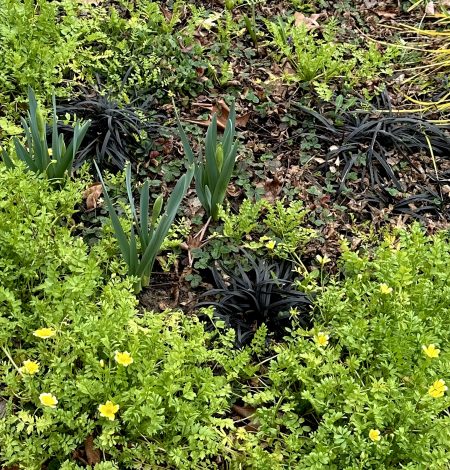
Where perennials like black mondo grass are slowly establishing their spread, annual Douglas meadowfoam fills the voids.