Waiting out front for Aaron to grab his down vest, I noticed geese flying overhead in a V. The smell of fermenting figs swirled with the first fallen leaves. Both scampered down the street to chase an orange tomcat.
The sky was clear blue. It hadn’t rained for days, maybe weeks, while news of hurricanes and floods permeated our parched minds. I imagined my unirrigated garden to be jealous of the news, but then remembered the devastation of such extreme climate events—heartache welled over the fleeting envy.
We walked toward the river, passed the rose garden (I plucked one full-petaled, shell-pink bloom and held it to my nose every few steps, the scent soft, old-fashioned).
Alongside the bike path, clinging to the steep river bank, big leaf maples swayed their toasty-splotched leaves, offering mottled browns as a crisp attempt at fall color.
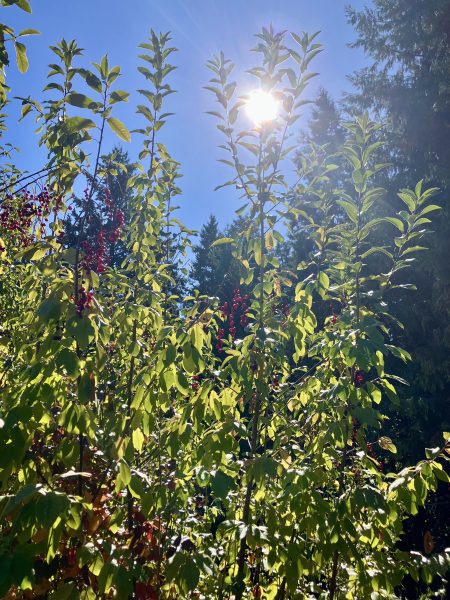
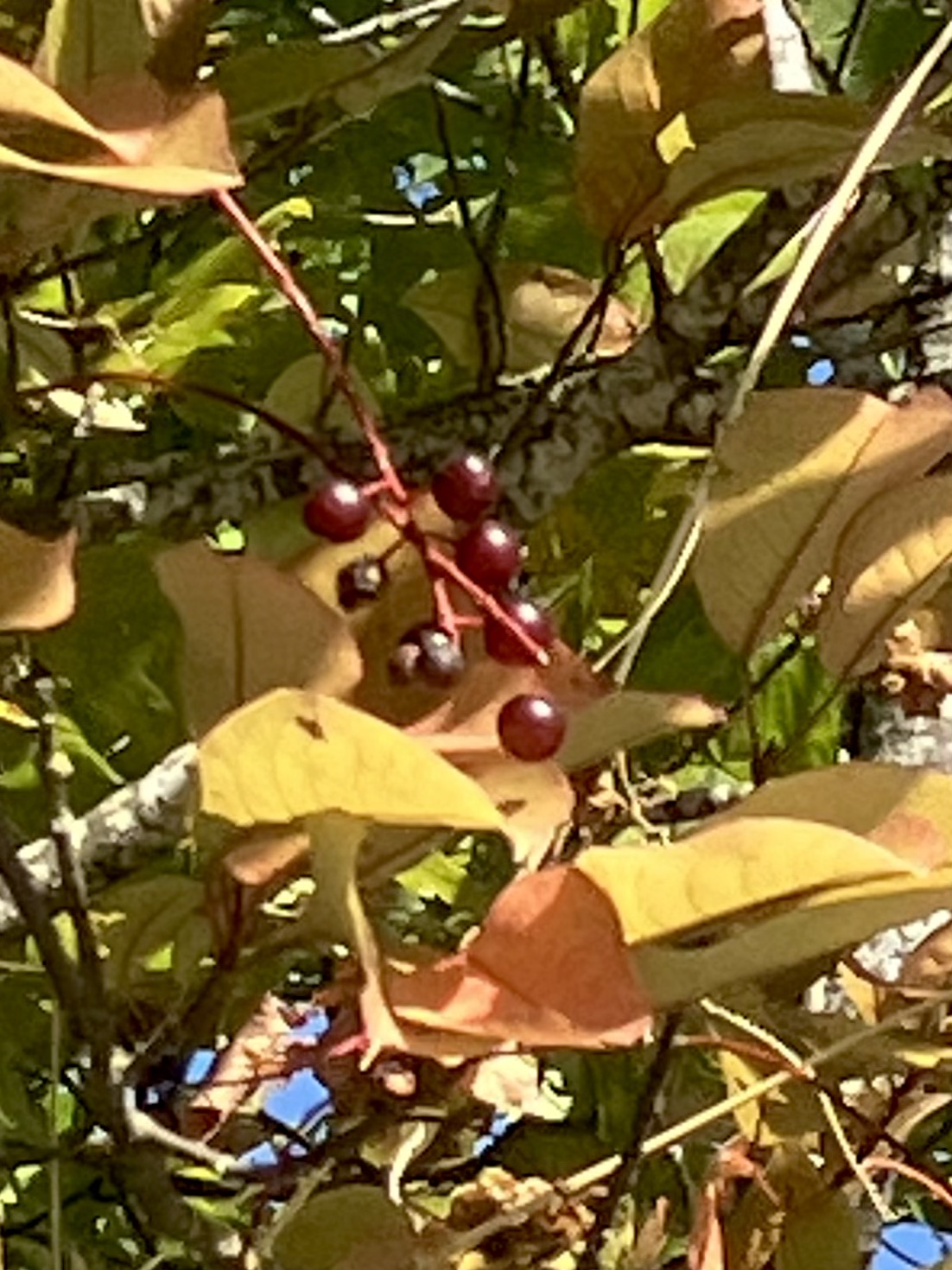
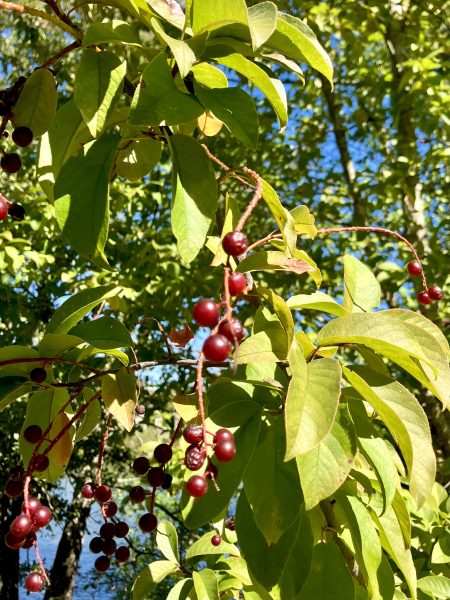
Then, ahh, the warm honeyed-rose of chokecherry leaves flagging in the wind. “Aren’t they lovely?” I grasp Aaron’s arm, pausing to admire. “Chokecherries,” he confirms. And we walk on, hand in hand.
“My hedge essay came out in Pacific Horticulture today,” I tell him. Chokecherries make an appearance in the piece.
I drift in my own thoughts about this small tree. My mind loves to ponder plants. Our footsteps beat a contemplative rhythm.
Chokecherries (Prunus virginiana) are in the same genus as over-planted English laurel. But, they make a friendlier hedge, being native and full of birds browsing and pollinators nectaring.
I wonder about the trio we planted some fifteen years ago along the fenceline of one of our larger projects. How tall have they grown? Twelve feet? Twenty? More? Has anyone ever sheared a chokecherry hedge the same way as a laurel hedge? That could be interesting.
In another garden, more recently, we planted three young chokecherries with suckers bursting out the drain holes of their nursery pots (I’d nicked my thigh wrestling and cutting the pot off one.) There, a path arcs between the chokecherries. For the design, I envisioned them maturing to a grove of many slender trunks, a native version of timber bamboo. (Both plants spread by underground rhizomes.) To walk though would be to immerse yourself in a mini forest, leafy patterns overhead, white-splotched bark companionable, bird chatter all around.

This time of year, it’s the fall color I adore, so warm and soft, especially when the shine of their blood-black berries is revealed in contrast. Winter’s discovery is the slender grace of the wood. Before leafing out in the spring, long racemes, like squirrel-tails, of white flowers sway their scent on the new breezes (pleasantly or less so depends upon the one sniffing).

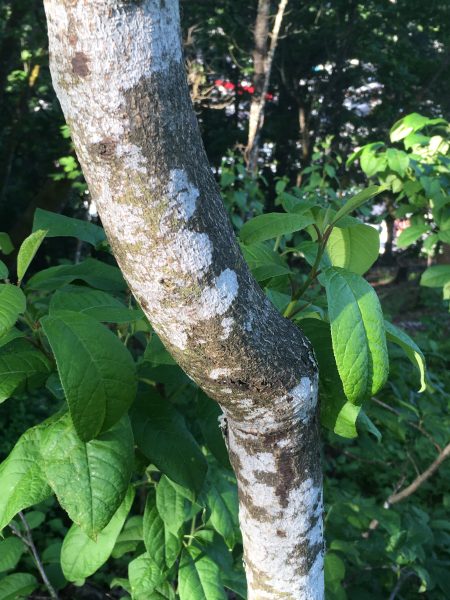
Chokecherries, native across much of North America, typically grow here in the southern Willamette Valley in stream-side areas like the stand we passed on the bike path. They’re excellent at grasping steep ground and keeping the eroding forces of flowing water in check. However, there’s one beauty, always flocked with birds this time of year, alongside the stairs on the hot, dry, west face of Skinner’s Butte, far from river or stream. That one has fewer and less vigorous suckers. The lean ground curbs it’s spread—a lesson for gardeners who fear chokecherry’s vigor: simply refrain from amending your soil or irrigating!
Some 240 (!) butterfly and moth species use chokecherry as a caterpillar host plant in the Pacific Northwest: coral hairstreak, hummingbird clearwing, small-eyed sphinx, Isabella tiger moth (better known in caterpillar form as wooly bear). It’s this diversity that puts chokecherry at the top of keystone species lists.
Once, I saw little protruding nubs on the leaves and wondered. INaturalist filled me in on the mystery. The chokecherry finger gall mite was in residence, nibbling and laying eggs, living its best life at microscopic scale.
Planting this chokecherry in your garden is an easy way to set the table for so many small creatures; native bees find what they need in the blooms, caterpillars from the leaves, birds from the caterpillars and the berries. It’s an entire food web rising along your fenceline, a delight of bumblebees, butterflies, robins, house finches, cedar waxwings.
Named for the astringent, acidic taste of its dark red cherries, indigenous peoples across North America cook or dry them to mellow the pucker. Sugared jam, I’ve heard, can also be a treat.
The leaves, stems, and seeds are poisonous, though. Educate children who may encounter its gleaming fruit how to be in right relationship with chokecherry. It demands this respect. Livestock, with minds of their own, are best pastured in a field without such temptations.
We walked on, Aaron and I, into the neighborhood where we’d planted hedges and gardens so many years ago. We saw a new gap in the street-side mixed hedge that I’d described in my latest Pacific Horticulture essay. I peered in over the top of the cut-back silverberry, “Hello, old friends in there.”
Down the block, a tall stand of Oregon grape flourishes in another hedge-like planting—lovely in high gloss green. Then, we came upon a four-ish foot tall row of sheared snowberries in front of a short fence. “Look, shearing works for snowberries. Still full of fruit.” Aaron nodded his appreciation.
But rarely do I see gardeners plant hedges of that most fall-colorful, dynamically full-of-life, wild beauty that we’d admired on the start of our stroll. Why not? Could you consider chokecherry for your fall planting this year?