Lawn-Free Garden Design
October 15, 2025
This essay was originally written for and published in the Hardy Plant Society of Oregon Quarterly Magazine. Thanks to their editors for the improvements.
___________________________________________________________________________________________________________
It was green, at least there was that, but the chore of pushing the reel mower over its expanse had become unbearable. Even when her kids were little, they played in the driveway instead of the lawn with its ball-stealing, ankle-twisting slope. The question for my friend now was what the lawn could become instead.
When I suggested we replace it with a sitting nook immersed in layers of flowers and bird-filled shrubs, her face lifted, her eyes brightened, and she gasped, “Yes, please!”
In this essay, I’ll take you on a tour of three lawn-free gardens—one extra -small, one standard sized, and one that’s more expansive. Let them inspire you to eliminate resource-intensive lawn with a new artistic layout for your own garden. Whether you seek to create more outdoor living space, or more habitat for pollinators and birds, or simply more ground for your growing plant collection, a considered approach to the design of your garden’s layout will refresh your garden experience.
Traditionally, lawn oozes amoeba-like, spreading everywhere. It’s the default groundcover, with only a narrow strip of foundation shrubs and a circle cut out for a solitary shade tree. As avid gardeners, you chop out and expand these initial beds as needed to accommodate your nursery haul or generous divisions from friends. The lawn continues to ooze around, but now it’s in increasingly narrower bands and bulges.
What’s missing with this piecemeal approach to garden-making? You might walk through the space and admire the combinations of foliage and flower and feel awash in their beauty. I love that!
And, you also have an opportunity to make art of the hardscape, to add intention to the overall layout of the space. The experience of walking garden paths or resting on patios whose flow and form are integral to the garden’s design adds a resilience and peacefulness to your outdoors. It’s this grounding patterning that hodgepodge accumulation lacks.
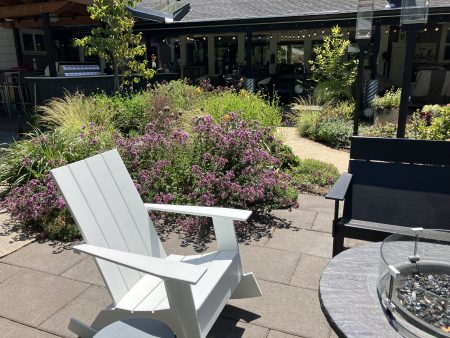
A lawn-free garden can be designed for living in.
Beyond that felt sense of legibility, a lawn-free design can reduce maintenance. Go ahead and retire your mower and your edger. Reduce irrigation and fertilization. There are more pleasant and meaningful tasks to enjoy here now—like resting, face uplifted to the rare winter sun, with feet light on a new mud-free surface of stone or woodchips, or laughing with friends round an evening fire on your new, amply scaled patio.
You Can Have It Small
No, your yard is not too small to get rid of the lawn. You, too, can have the sanctuary of a richly planted garden with all the benefits of connecting to the living dynamic of nature. Even a tiny lot is improved with thoughtful design, especially when that design eliminates the unnecessary element of a lawn.
Kristi and Jon Schneider’s Suburban Wilderness Garden shows you how to do it in a 755 square-foot, suburban, Eugene, Oregon, front yard.

Kristi and Jon’s small front lawn was good for Christmas decor but not much else.
First, claim as much unpaved ground as you can for plants. Don’t overcomplicate your small yard with too many paths or other bulky elements.
There was an impulse here to make a path through the front bed around to the side gate. Why? Only because the existing lawn had that kind of “go-everywhere” access. When we considered the flow, though, there was no reason for that. Instead, we’ve immersed Jon and Kristi’s front porch in the greatest depth and layering of plantings.
Kristi loves birds and knows the importance of providing water. A bulky fountain would be out of scale here, though. Instead, a copper bird bath, floating above the flowering perennials and grasses, rises on a slender post. All the available ground is for roots and their shoots.

The newly planted mix of natives, including great camas (Camassia leichtlinii) and Western buttercup (Ranunculus occidentalis) attracted pollinators immediately. A slender-stemmed birdbath hovers above.
Second, keep feet out of the garden with a low fence. Without a lawn, the design needs to clearly show where to walk. This is especially true in a small yard, and even more so if it borders a public sidewalk.
People (and dogs) are used to walking wherever they want in the world of lawn-as-groundcover. An edging fence tells everyone that there’s something here that deserves protection. Woven willow or bamboo are sustainable options that add beauty to the overall design.

Woven willow fencing adds charm and protection to Kristi and Jon’s small garden, while large flagstones provide a generous, stable walkway to the front door.
This kind of edging fence does double duty in the height of summer. Long stemmed flowers get a little support from the structure. Instead of flopping into the path, the blooms lounge romantically on the willow. The combination could make for your best garden photo.
Standard Size Yard, Nonconforming Style
A front lawn used to be thought of as democratic; that it represented a generosity to your community. The continuous green sward was open to all. It was both status symbol and societal conformity.
Gardeners like Sarah Mahler-Newton now seek a different kind of generosity, an ethical aesthetic. Colorful blooms and shade-making trees, native plants full of pollinators, the peace and quiet of mower-free weekends—this is what her new lawn-free front yard offers.
Sarah’s Tropic of Oregon Garden, in Eugene, Oregon, is the first on its block to embrace this new aesthetic. It demonstrates a strategy worth emulating.
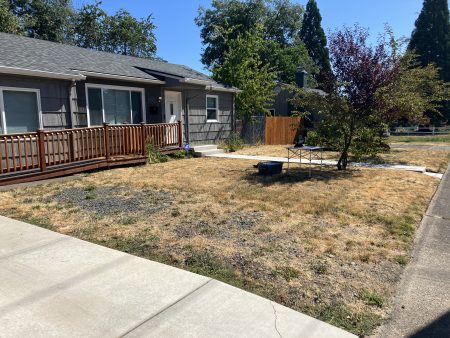
Before: Sarah’s standard sized yard was sad and devoid of life.
Eliminating lawn always involves the question of what covers the ground instead, especially in zones meant for people to walk or gather.
Here, we made use of the most ecological and affordable option: woodchips. Compared to pavers, flagstones, or even gravel, woodchips are easy for anybody to install. They’re also locally abundant, permeable, and soft underfoot. The type used in playgrounds is splinter free and can last many years before it needs to be refreshed.
Woodchips also do curves well, and Sarah loves the feel of curves. I gave her a tendril path that swells to allow for flexible seating. Describing the flowing lines of the path with black metal edging retains the intention of the design. Without edging, the shape of the open area would grow fuzzy and illegible over time.

After: In its second year, Sarah’s garden explodes with color along a curving path of woodchips marked by metal edging. Oregon sunshine (Eriophyllum lanatum) and Paprika yarrow (Achilllea millefolium ‘Paprika’) are the red and yellow, pollinator-attracting flowers seen in the bed at left.
My favorite thing about woodchips is how resistant they are to weed invasion—if installed properly. Have you ever seen mini mounds of mud emerging above the surface of a chipped path? Those invitations for weed seeds to sprout are the industry of earthworms, continuously cycling material from the depths to the surface and from the surface to the depths. As much as we appreciate this activity in garden beds, and would never use landscape cloth there, paths and patios will be more resilient if you suppress that churning. Landscape cloth under a 4 to 6-inch depth of woodchips functions to maintain the material mud and weed free. Which means more time for you to enjoy sitting or strolling rather than bending and tending.

Drought-adapted plants like California fuchsia (Epilobium californicum) and Valerie Finnis artemisia (Artemisia ludoviciana ‘Valerie Finnis’) look lush with minimal irrigation in the full sun exposure that fried Sarah’s lawn.
With simple materials laid out gracefully, including ornamental and native plants, but no lawn, Sarah now feels awash in the joy of color every time she steps out her door. That’s my kind of democratic generosity.
Expansive Scope, Immersive Experience
The final garden on our tour is one “room” of many on a larger property owned by Ami and Jeff Hill in Eugene, Oregon. Here, the art of mixed materials defines the Sun Garden. It’s a social space immersed in fiery-hued foliage and bloom.
An S-curving path of decomposed granite guides you from the covered patio out towards a garden shed. Mid-way along this path, large rectangular pavers intercept the flow, graphically inviting you to sit in the heart of the garden around a central fireplace.

A new S-curved path of decomposed granite, flows through Ami Hill’s expansive space and is interrupted by the grid of pavers topped by the fire pit.
Or, you can enter the Sun Garden from the outdoor kitchen via large flagstone stepstones, whose natural shapes join up with the rectilinear patio with one smart cut at their meeting joint.
It feels like a sculpture that you get to inhabit, that draws you into it intimately, immersing you in nature as a player, as a dynamic part of the scene, rather than a remote spectator.
A larger property allows you to play with ground plane materials and the patterns they make in a way that defines the garden as abstract art. Just like mixing plants to create vignettes, a considered combination of paving materials adds to the beauty of your garden.

In the fullness of summer, Ami’s curving path is immersed in blooms.
The crunch of gravel gives way to smooth stone. Soft wood chips meet neatly laid pavers. The experience of moving through the garden is elevated by these sensory changes. Patios paved in a distinct material echo the indoor environment where rugs define a room. Paths are like hallways, sometimes carpeted and soft, other times cool and smooth.
In your larger garden, have fun with flow and pattern. Let the variety of materials shine as a foreground to your plantings. There’s no need to keep a high maintenance lawn when so many other options are available for covering the ground that you walk on.
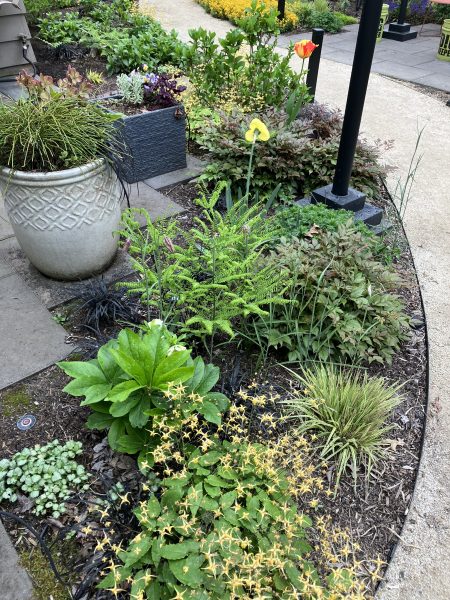
Bed shapes defined by varied material are interesting in their own way—even more so with textured foliage and blooms.
Conclusion
It’s a weekend morning in spring. You hear distant lawnmowers droning, reminding you of the work that once claimed your free time. Instead, you now enjoy a leisurely coffee in the fresh sunlight, gaze soft upon the rising green and bloom. A hummingbird zings by overhead. You breathe in the scent of magnolia and cottonwood. A blanketing sense of calm ease suffuses your limbs and your mind. This is the result of your efforts towards a lawn-free garden design that’s just right for your private piece of the outdoors.