Plant More Plants
June 10, 2026
“That’s way too many plants,” is something you’ll never hear me say.
Shifting baseline syndrome is a term ecologists use to describe how our definition of “wild” changes with the current condition of wilderness. As we lose species diversity, we become use to less and less complexity, less life, less wilderness. And we forget what we’re missing, what our grandparents knew wilderness to mean.
The same is true for the cultivated grounds around your home. Your baseline for what looks good changes by what you’re exposed to in your neighborhood. The aesthetic of meatball sheared shrubs with empty, bark mulched space between them is so common that that’s become the baseline for a “good” home landscape.
What happens though, when you expose yourself to the remnant wildflower beauty of, say Tire Mountain, or Finley Wildlife Refuge where a rambunctious mix of foliage and flower jostle and weave? What if you use that as your model of what you want your home landscape to look like? You’ve shifted your baseline to reflect unburdened nature, to be abundant with plants of varying colors, textures, and heights. You create a front yard to delight your neighbors and, in turn, their baseline shifts.
Two recent photos from my hike on Tire Mountain received more giddy hearts and comments than usual when I posted them on my Instagram stories. Both show an absolute riot of plants interwoven with each other, one basking in bright sunlight, the other in heavy, coniferous shade. I take the enthusiasm to mean that you see wild abundance as beautiful. Your baseline is positively influenced by exposure to examples of natural plant density. Take a look now and notice your gut reaction.
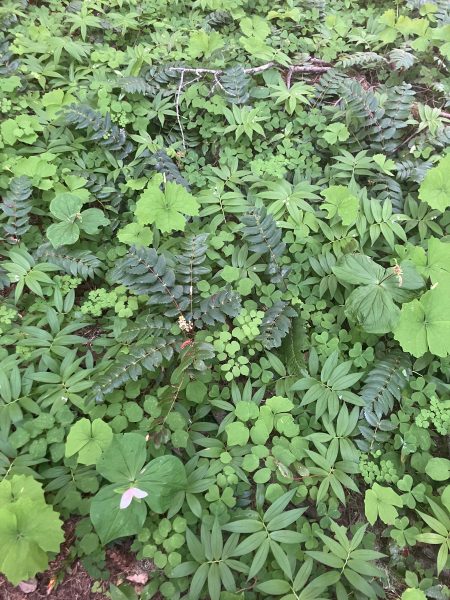
This mix on the forest floor includes: Pacific trillium, Cascade Oregon grape, starry Solomon’s seal, vanilla leaf, inside-out flower, wood sorrel and no weeds!

In full sun and lean soil, plant density can also by high. Here: red paintbrush, Oregon sunshine, sea blush, blue-eyed mary, and a grass grow together along the trail.
Would you like to walk out your door and see something similar? How can you imitate the master of all planting design, Mother Nature herself?
I’m going to give you a very simplified answer with the hope that it inspires you to play and experiment in just the same way that trial and error has evolved self-willed plant communities everywhere:
Plant more plants!
If only we could enter a garden center and purchase a pot of not one, but a whole intermingled community of plants ready to establish in any microclimate. Most growers diligently weed their container stock, even if the weeds are desirable volunteers. Every once in a while you’ll get a happy hitchhiker, like the candy flower that came along with a deer fern from my friend Lorrie, or the Douglas spiraea that shot up from the young snowberry in Tammy’s garden.
Plant more plants because more plants layered and mingled is joy on the land, is habitat, beauty, and, importantly, more plants means less weeds.
More plants of different types and more repetition of the same. More self-seeding annuals, more bulbs, more clumping and more spreading perennials, more shrubs, more trees. You can always edit later. For now, plant more plants.