Red-flowering Waterfall
March 9, 2026
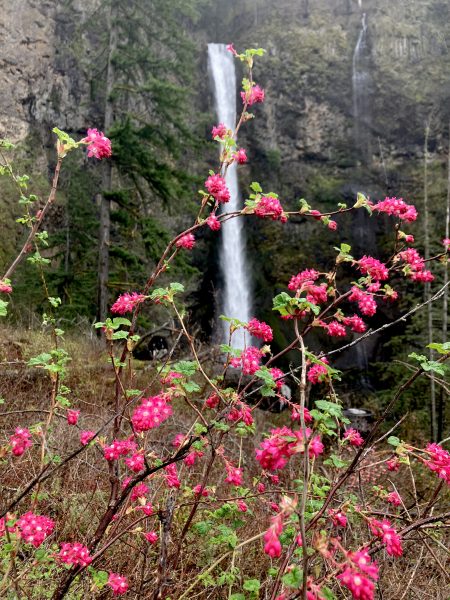
Bent at an unflattering angle to get the blooms backgrounded by the falls, I heard Alder call from the trail above. His long legs and distance runner’s lungs were constantly carrying him two or three switchbacks ahead of me. Plus, I had to keep stopping to admire the flowers.
Last spring break, my son Alder and I took the Columbia Gorge Express bus from Portland to Multnomah Falls. The trip combined three of our shared loves: public transportation, waterfalls, and wildflowers.
The trail to the top view of Multnomah Falls was wet, steep, and populated with visitors speaking Japanese, Italian, German, and mid-western American accented English. Hummingbirds clicked and zipped by, startling my gaze upward from the slick trail. A party of pinks decorated the thin soil of the rocky cliff face—saturated magenta mostly, but some paler blushing blooms too. I’d never seen so much of our Oregon native red-flowering currant (Ribes sanguineum) in full peak bloom in the wild before.

Around Eugene, on Moon Mountain or Spencer’s Butte, I’ve spied many lanky branched red-flowering currants reaching from dark shade to throw a cluster of blooms here or there. But, only in gardens had I seen them as full and robust as they grew along the Multnomah Falls trail.
Garden grown red-flowering currants can grow so robust, in fact, that some people are inclined to chop their heads off. Usually this happens if the shrub is planted in the wrong spot, like in a tight corner under a home’s window. Then, whack, out comes the loppers to disfigure the poor thing.
Seeing them growing so gracefully at Multnomah Falls reminded me of red-flowering currant’s best garden placement: a spot with room to stretch, where winds blow and sun slants friendly rays. Never cramped or squeezed, not tucked up under eaves, but placed with pride and only low growing companions nearby, and maybe a boulder or two.
Blooming at the same time with the red-flowering currant at Multnomah Falls were my favorite spring sweethearts: the Nuttall’s toothwort (Cardamine nuttallii.) If you’re familiar with the four petaled flowers of garden vegetable brassicas (like arugula, kale, and broccoli), this bloom will look familiar. In blushing pink, she rises on a single stalk with one leaf of three slender fingers. The ground level foliage is completely different though—rounded and broadly lobed. I’ve read that this plant was a popular food source for the First Nations people who’ve inhabited Oregon for millennia. Do they taste sharp like arugula or mustard? Or sweet like a fresh cabbage? I’ve yet to see Nuttall’s toothwort available in native plant nurseries, but perhaps I’ll seek out seeds and try to propagate some myself.

In the meantime, pairing our native currant with garden daffodils is fun or with winter daphne and violets. Our state flower, the tall Oregon grape blooms yellow in March making a colorful companion to red-flowering currant, but, again, don’t crowd them together. Rather, place the currant six, eight, even ten feet on center away from any neighboring shrubs. She grows naturally into an upright vase shape that is elegant with very little pruning. Here you can follow the three D’s approach to pruning: only cut the dead, damaged or, diseased limbs. Please don’t chop her head off!
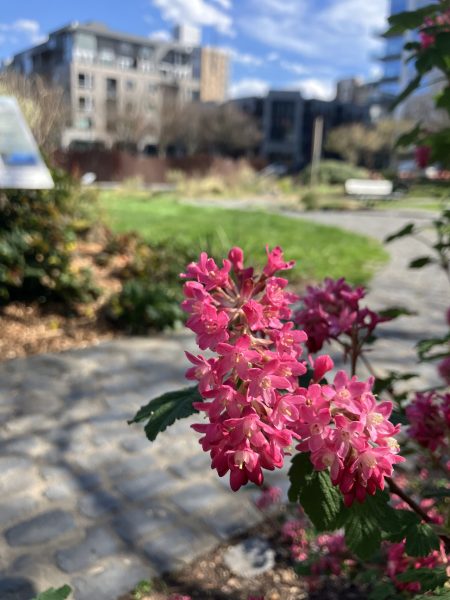
Tanner Spring Park in Portland also boasts many lovely red-flowering currants.

The paler pink form is commonly found from local native nurseries.

This one, called Ribes x gordonianum, is a hybrid of Ribes sanguineum and the yellow eastern Ribes odoratum. I picked it up from Xera Nursery for a client who prefers oranges to pinks in her garden. From afar, these blended flowers read as salmon.

The view from the top of the Multnomah Falls trail embraces the broad Columbia River and all her rocky cliffs.

Few visitors continue on past the peak where the terrain grows wildly rugged and dark.
Such a beautiful entry. Lovey -inspiration and hope – what we need in these times! You mentioned Moon Mountain – do you live here in the Laurel Hill Valley?! Thank you for your offerings.
Thank you Wendy! I don’t live near Moon Mountain, but I love exploring there. Have you seen how the red-flowering currant along the trails there often looks like it’s reaching for more sun?