
Down the road from the new housing development—with its astroturf, young trees planted too deeply, staked with girdling ties, straight rows of nandina, pennisetum grasses sheared prematurely, shaped into pert little cones like straw Christmas trees—lies a remnant of wild beauty.
There, I walked companionably with my brother on my birthday, the last day of November, in a rare golden glow that streamed through ancient trees. I pointed to healthy Western red cedars shouldering up to big leaf maples and sheltering young hemlocks. He spoke of picking thimbleberries in the summer and decompressing along the trails after work.

Along the fringe of the nature park, nearby neighbors have extended their gardening like fingers of cultivation reaching into the wildness. Lemony golden cypress stand sentinel near sprawling arms of red elderberry. Thick bark mulch smothers the rank growth of weedy grasses, benches invite birding contemplation, and dried stalks of planted milkweed demonstrate an acknowledgment of wildlife’s dependence on native plants.
I saw images of Jeanne K Simmons’ artwork recently where she’s braided humans into nature, literally. A woman’s long plaited hair continues into grass strands, the mixed braid blurring the edge of lady and green ground. Another shows a person’s face calm, at rest, emerging from a cocoon of woven grasses still rooted to the earth, rooting the person in a gentle embrace.
There’s something about partnership that I want to explore here, something about how two plants growing together—rosehips and snowberries, beautyberry and midwinter fire dogwood—are the beginning of community, the beginning of natural beauty.

And the partnership of gardener and nature, not one controlling the other, but in conversation, an emotionally intelligent partnership, nothing abusive. Observing and contributing. Mutually supporting. Bringing out the best in each other.
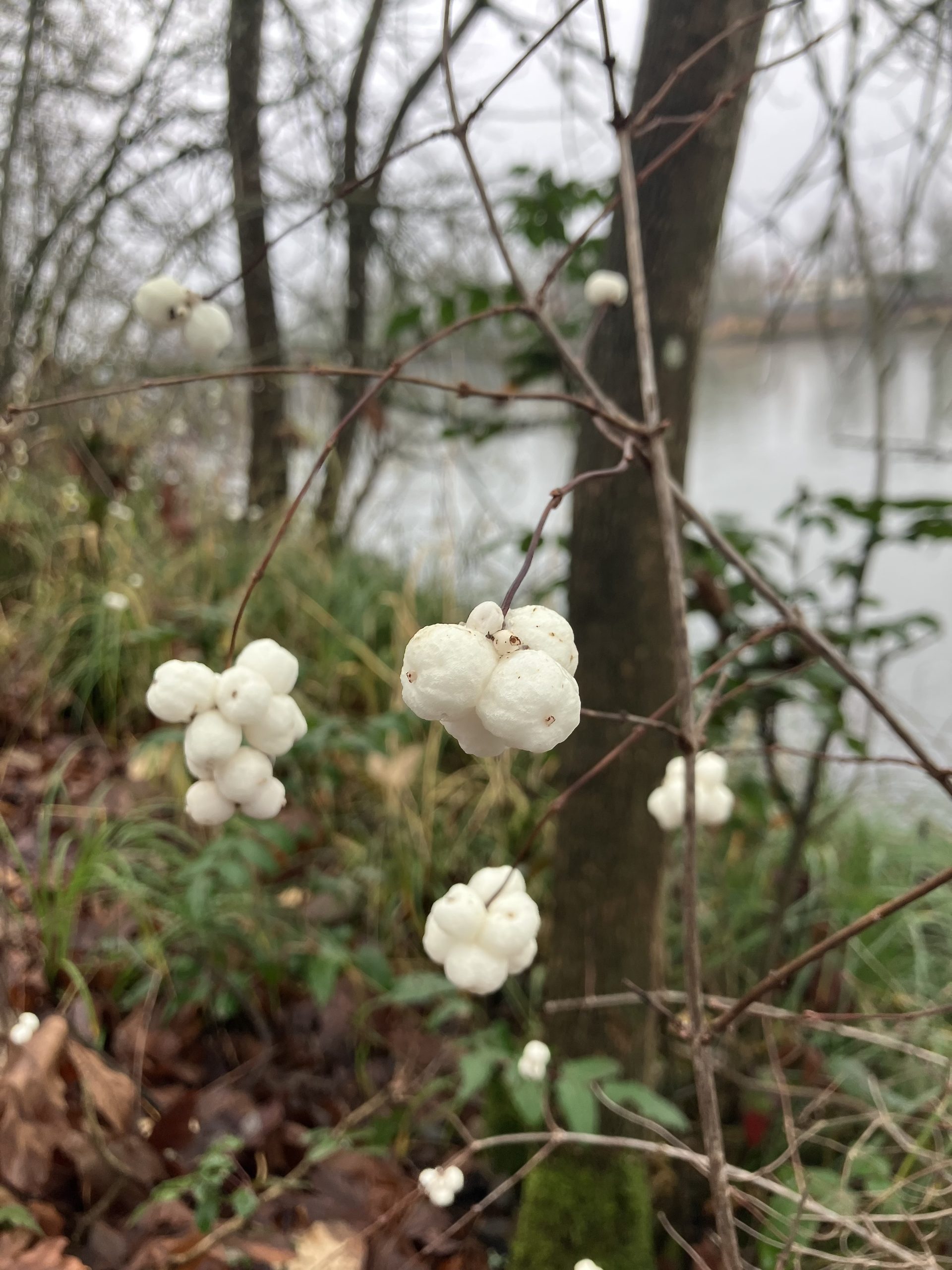
Yes, it does start with the positive connection between two. Take the wild rose and snowberry example. I saw these intermingling on a small bank near the trailhead. White berries sparkling, red hips gleaming, alive at times, I imagine, with feathers and birdsong. Two species together making each other more beautiful, complimenting each other, initiating community.
I think a lot about plant communities in my work as a landscape designer. I want your gardens to look great year-round and, equally, to naturalize without a lot of work. That means, to me, making sure the planting combinations are layered just so, complimentary, harmonious. That means communities. And, a community starts with a partnership. Then partners of partnerships, and so on.
The clear yellow of thimbleberry leaves clinging to thin stalks late into autumn glow in contrast to the deep green of sword ferns carpeting the ground below. Partnership.
A slope-stabilizing thicket of nootka rose, tall and arching, supported around it’s leggier bits by the twigginess of snowberry. Partnership.

Like peas and carrots, or mashed potatoes and gravy, apple pie and whipped cream, two together are better than one.
If you want to plant, say a hellebore, this winter, because you’ve admired their lovely winter blooms, pair it up with something complimentary. Maybe early narcissus for simultaneous flowering, or a few little bunchberries to carpet the ground beneath.
Planting naturalistic communities gives you more to enjoy, for sure, but it’s also the way to reduce maintenance. Layers outcompete weeds, support each other structurally, increase habitat for beneficial insects, repel deer, and more.
But if you find it overwhelming to plan your own garden as an entire composed orchestra, just start with a partnership of two.
Individual plants in a row, the way builders installed in the housing development, are lonely. They smell the wild array from the nearby nature park and yearn for a partner of their own. Pennisetum could kiss a ground covered in kinnickinnik. Nandina, well, I don’t have much encouragement for you, overused, toxic to bird bush, but maybe we could replace you with native creeping mahonia and partner that with the equally creeping western mugwort.
Weave one with another. That’s the beginning of community.