September is Read in Asters
September 17, 2025

There’s a field I walk weekly with my friend Jamie and our two reactive dogs. It’s filled with a succession of wildflowers. There’s something blooming nearly every month of the year. The dogs notice the shift in smells, their noses ever curious. Jamie and I are more visual, noting the blues and yellows of camas and buttercup giving way to pink bobbles of narrow leaf allium, then yellow again with gumweed.
“It must be September!” I said to Jamie this morning. Dropping a knee to brittle grass, I touch the pale star blooming amidst all the blondes of latest summer. Aster is blooming bravely, right on time.
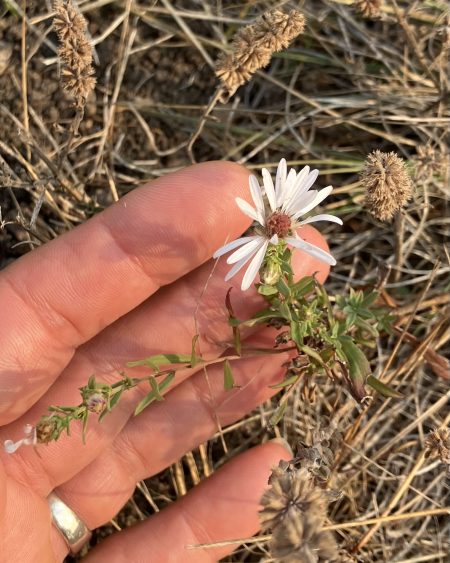
When flowers inscribe the months upon the ground, September is read in asters.
There’s something about succession in nature that I find especially comforting now. Succession is defined as a “replacement of organisms over time, an act of following in sequence,” or even “a passing of royal powers.”
The first blooms of the changing season are the protesters resisting ICE, the shining moral beauty of a community looking out for each other, the alternate pathway towards peace and truth. Nature demonstrates a constantly changing regime. The approaching Fall season brings renewal with fresh rains drawing forth vibrance from trodden ground.
In your garden, as in the wildflower fields, asters in bloom signify the passing of royal powers from high summer to early autumn. A fresh change of robe, a succession rising, alive with buzzing pollinators and sparkling in the new morning dew.

Many garden asters have been selected from New England and Midwest species. Here in the Pacific Northwest, though, we have three of our very own to celebrate.
Douglas aster (Symphyotrichum subspicatum) has reached celebrity status as the flower who feeds the most diversity and abundance of native bees.

This is a perennial perfectly suited to covering large swathes of bare ground in sun or in dappled shade. It’s style of growth is sometimes called “aggressive”, but that adjective doesn’t respect Douglas aster’s ecological role or function in a garden planting.
Their spreading rhizomes grip sloping ground, effectively preventing erosion along stream banks. Occasional flooding is taken in stride. Rain gardens and bioswales need Douglas aster.
The density of Douglas aster’s leaf cover resists weed seed invasion, making this a low maintenance solution. Where ecologically barren lawn has become the default, you could instead choose a Douglas aster community. Enjoy pollen-rich, purple beauty instead of mow and blow purgatory.
Goldenrod (Solidago sp.) is aster’s iconic companion. The natural artistry of this purple and yellow combination enchanted celebrated author Robin Wall Kimmerer. She cites its beauty as the inspiration leading her to study botany. Why not mimic this pairing in your garden?
You can also combine Douglas aster in your sunny habitat garden with equally vigorous yarrow (Achillea millefolium), fireweed (Chamaenerion angustifolium) and Western mugwort (Artemisia ludoviciana). Stud the mix with tufted hair grass (Deschampsia cespitosa) to add an ethereal golden glow. Hide the fading foliage of spring blooming big-leaf lupine (Lupinus polyphyllus) with Douglas aster’s late summer leafiness. On the edge of a shadier zone, snowberries (Symphoricarpus albus) makes a festive companion with their white bobbles dancing alongside aster’s purple stars.
Planting multiple patches of this pollinator favorite in differing amounts of sunlight throughout your garden is a great way to extend the bloom time for your foraging bee friends—sunny plantings will flower first, then go to seed when the shaded plants are just coming into bloom.
Pacific aster (Symphyotrichum chilense) is very similar to Douglas aster. They can be confused in the nurseries for each other. But don’t worry, they’re both great plants, equally attractive to many pollinators—bees, butterflies, moths, and more! Pacific aster seems to have broader leaves than Douglas and spreads perhaps even more vigorously, but I use them interchangeably in planting designs.

Adaptable to irrigation or drought, sun or quite a bit of shade, this wildflower is very easy to grow. Deadhead it for repeat bloom and / or let it set seeds for birds to eat. Just don’t plant it alongside a delicate darling that will get engulfed by the rambunctious nature of Pacific aster.
Though the specific epithet chilense seems to indicate that this aster is from Chile, that was a mistake whose name stuck around anyway. The common name of “Pacific” is more accurate of it’s native range all along the west coast of North America.
(Speaking of botanical names, if you’re wondering what’s going on with the cumbersome genus name of Symphyotrichum, you’re not alone. Aster is such a beautiful name. Why did it change to that stumbling mouthful? Researchers discovered in 1994 that Eurasian aster species are genetically distinct from North American asters. The old world plants got to keep the pretty name while here we got Symphyotrichum instead. Lucky us.)
Hall’s aster (Symphyotrichum hallii) is my current favorite, so I’m glad you’re still reading! This is the little cutie that caught my eye in the Sniffspot field where I walk weekly with Jamie and our dogs. It’s the best native aster for a smaller garden or a highly mixed planting because it spreads more moderately than Douglas or Pacific aster.
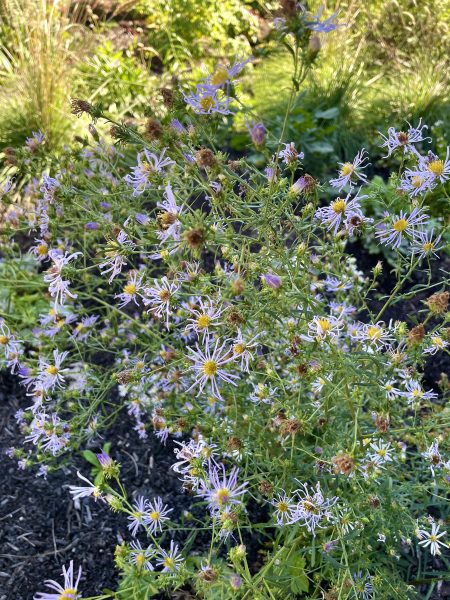
When I asked my client Kristi how her young Hall’s aster were doing, she replied that they were “super interesting and wispy, with both white and light purple flowers”. On slow mornings when she can linger with coffee, she’s still seeing bees in her lawn-free front garden thanks to the Hall’s aster.
Found almost exclusively in the Willamette Valley, Hall’s aster in your garden offers that special, hometown, sense-of-place pride. Go Halls! It can be harder than the others to find in the nurseries. Willamette Wildlings offers seeds and, occasionally, plants for sale. Do seek it out!
Prairie June grass (Koeleria macrantha), with it’s blonde spikes, makes a lovely companion to Hall’s aster’s mound of stars. Meadow checkermallow (Sidalcea campestris), if deadheaded after the first flush of bloom, will flower again alongside Hall’s aster with tall wisps of hollyhock-like blooms. A garden planting like this roots your garden firmly in the Willamette Valley in September.

When you find yourself saddened by the news and wondering if this current regime will ever change, step outside. Admire the asters. Breathe deeply the cooler morning air of September. In nature, as in politics, change is inevitable. Plant more natives. Show up in your community. The roots of a more hopeful future are gaining strength with every act of love.
May I have your permission to share this blog post with our Facebook group, “Friends of Pollinator Project Rogue Valley? Even though we are in the Rogue Valley and not the Willamette Valley and are very different climates, we do have many plants in common. I think your blog post is highly relevant to what we are experiencing here right now. At least I can speak for myself and for what’s blooming in my garden. Would that be alright with you? Thanks, Amy Myrin
Hi Amy,
Yes, of course, please do share it with the Friends of Pollinator Project Rogue Valley. Thank you!