Spiraea Pink
July 15, 2026
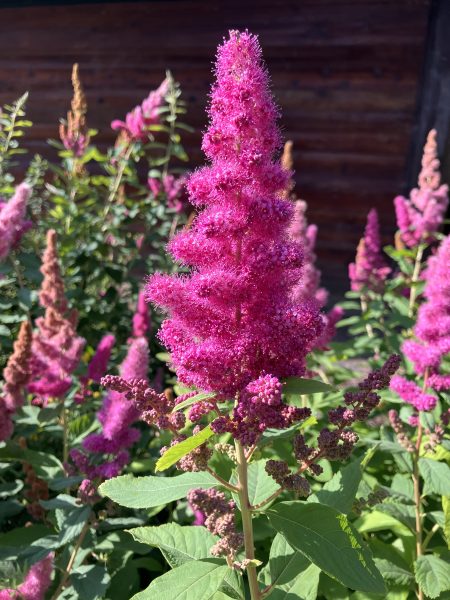
Spires of shocking pink rising from the greenery call to me. This is a color that says “look at me!” Closer, the fuzziness of Douglas spiraea (Spiraea douglasii) blooms beg also to be touched. I have to watch out that I don’t grasp a foraging bumblebee. These native summer flowers are popular with bees as well as with lazy winged butterflies.

Looking even closer, I see that each floral wand is a cluster of countless miniature blooms, little roses with a crazy array of pollen-tipped filaments and juicy bowls of nectar. Each flower is a tiny universe celebrating summer in the Pacific Northwest.

Douglas spiraea is also known as rose spiraea in honor of it’s pink hue. Working with clients for over twenty years designing gardens, I’ve learned that many of you have a strong preference for, or aversion to, pink.
Is it too “girly” for you? All the marketing since the mid-twentieth century tells us pink is strictly feminine. But, pink used to be a boys’ color—light red being the younger brother of scarlet-jacketed soldiers and red-robed cardinals.
Or does pink soothe your senses like a Waldorf kindergarten classroom? As the color of the heart, of love, of gentle joys it offers peace and beauty.
The color orange is often the other side of the equation. I get asked for gardens with pink flowers and no orange or vice versa. Rarely both.
This recent rose spiraea that called me closer was accompanied by pops of orange blooms all around the shrub’s base. Some daring gardener had planted butterfly weed (Asclepias tuberosa) in the same bed as the spiraea. And it looked absolutely fabulous!

When I was a little girl, my mom dressed me in an orange snowsuit to ski the slopes at Mt. Hood. She claims it was the only orange snowsuit on the mountain, making me easy to spot. My cousin Meridith wore a pink suit. The family story goes that we clashed so badly that we weren’t allowed to ride the chair lift together. Which may or may not be true, but I do know that neither of us loved to ski as much as the rest of the family, so I’m sure we sought each other out, defying the colored opinions of the adults.
This concept of orange and pink as clashing colors is confusing to me. It’s a deeply rooted notion from that ski slope situation. The garden planting design requests I get confirm that many of you see them this way, too. Then I look at a sunset over Paulina Lake or a glowing peach rose that contains both pink and orange and I wonder how they can ever be said to clash when they blend in to each other so naturally.
Douglas spiraea is a native shrub I’d like to see in gardens as a replacement for the weedy and ecologically impacting butterfly bush (Buddleia davidii). It may be a hard sell though for those of you opposed to pink. Would you accept it if were accompanied by an orange companion? Could you see the sunset in the combo?

Looking at Thea’s young garden exploding in first year blooms, we noticed that it was the orange of the milkweed (Asclepias tuberosa) that visually linked the pink clarkia (Clarkia amoena) to the yellow yarrow (Achillea ‘Moonshine’). It reads as a harmonizing flow of hue with the blue circles of ‘Rozanne’ geranium for a cool contrast.
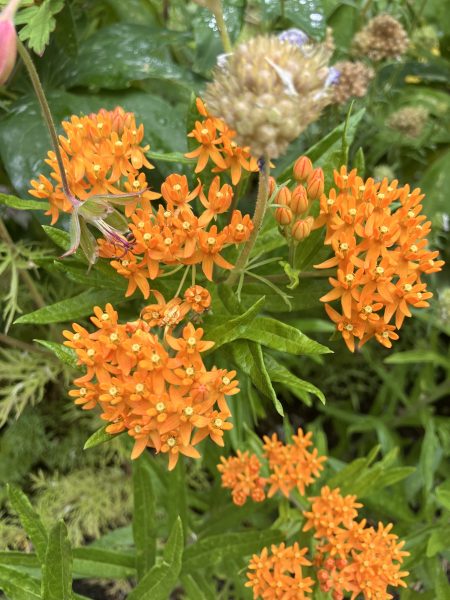
Milkweed (Asclepias tuberosa)
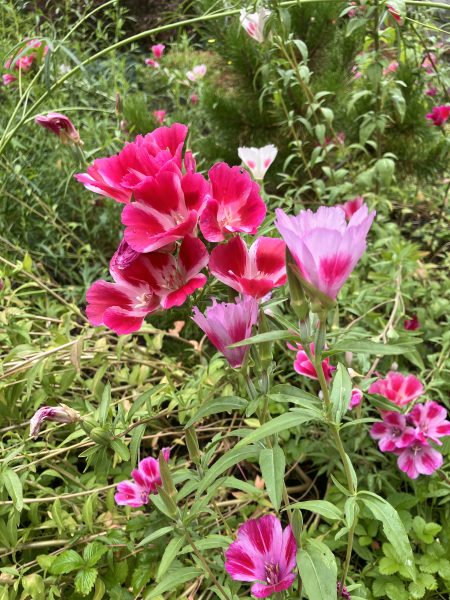
Clarkia aka farewell-to-spring (Clarkia amoena)
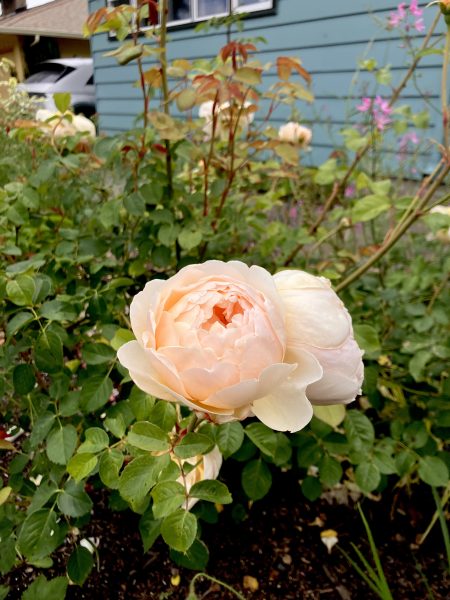
Is ‘Jude the Obscure’ orange, or pink, or both?

The saturated pink of the ranunculus harmonizes in intensity with the orange California poppies.

Dark orange Helenium ‘Moerheim Beauty’ and the fading red of Achillea ‘Pretty Woman’ look great to me. What do you think?
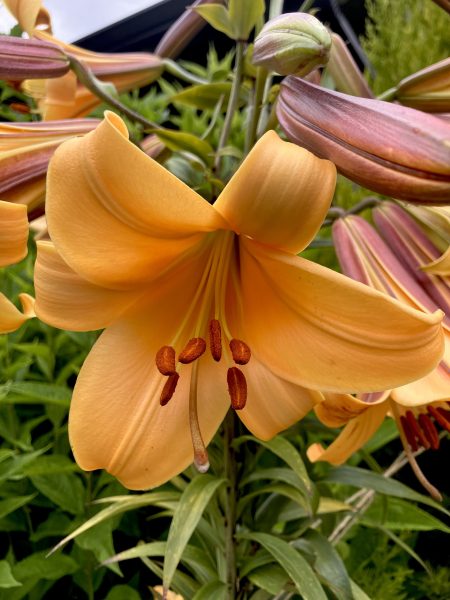
‘Copper Crown’ lily, with pinkish-purple buds, opens to reveal the warmest orange.

Collomia grandiflora is a native annual that blooms in a soft orange. I think even those uncomfortable with orange could enjoy this hue.

Something about these two together makes me itchy under the skin. Too red of an orange with too blue of a pink.
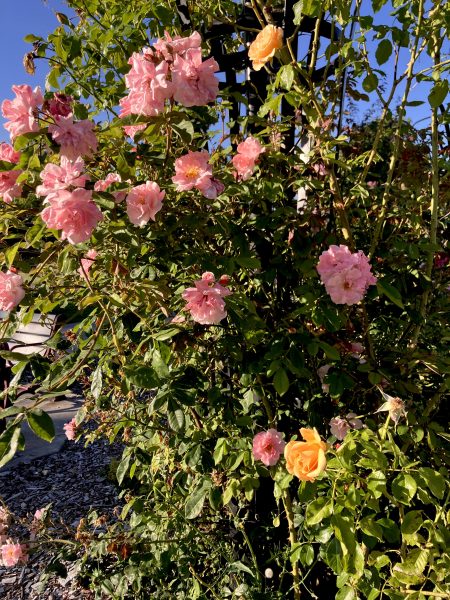
Two roses, pink and orange, complement each other like a sunset.

Sunset over Paulina Lake.
I think pink goes great with orange! And Douglas spirea is beautiful aesthetically, as well as being native and tough….but my question is…What has been your experience with it functionally in mixed plantings? Is it a bully to other plants and hard to control the spread of? Should I only plant it in contained areas surrounded by barriers like driveways and sidewalks?
Great question Eileen! Douglas spiraea is great in a mixed planting as long as you understand and respect it’s nature to mature to be a large shrub. It can grow up to 7 feet tall and wide. Give it the space it wants and plant it with companions that can match its vigor (like nootka rose, willows, red twig dogwood). It can live companionably with robust perennials like the milkweed too. It takes well to coppicing (pruning all shoots to the ground in late winter) to periodically reduce its height and renew the plant.
I am here for all of the pink and orange in multitudes of combinations! Thank you for this joyful and practical piece, Leslie. Your posts and designs are thought-provoking, horticulturally-informed, and romantic all at the same time. I’m curious if you’ve ever attempted to plant hardhack along with collomia. Although they are sited as plants that thrive in different conditions (moist sun and dry sun to part-shade,) I have seen hardhack growing in compacted, dry part shade. Coppicing hardhack is an interesting idea that I’d like to try. It’s been fun to experiment with Chelsea chopping fireweed after watching the deer do it, and getting shorter floriferous stems. I wonder if this is similar to what you see with hardhack in residential spaces.
Thanks for your kind words, Hillary! You’re right, hardhack (yet another name for Spiraea douglasii) can adapt to some pretty tough ground. I haven’t planted collomia with it. Yet! Let’s give it a try. I love that deer taught you to chelsea chop fireweed, and that you’ve passed that tip on to me now, too! Great idea to make a tall beauty fit a smaller garden. When I’ve coppiced spiraea, it shoots up nice new stems that are shorter than a fully mature plant, but just as wide as it was before pruning. I imagine I’m acting like a high flood in late winter, knocking down the old stems. The strong roots are quick to respond with new growth. You could coppice it every three to five years as needed. It’s a much better approach than shearing it with hedge trimmers like I see a lot of mow and blow folks do. That results in fewer blooms and a lot of inner deadwood, and an altogether lack of grace. You know, the old meatball shrubs.
Not quite pink but one of my favorite happy accidents in my garden is large groupings of purple echinacea and Asclepias tuberosa. I love it so much I relaxed and entire section if garden along a timber wall with this pair.
That’s sounds like a very happy combo. Love it! Thanks for sharing, Lindsay!
I’m in eastern Washington, so we tend to have more xeric plants but we have Pink Spirea that was a stowaway in a pot of Pearly Everlasting that I bought. It has been growing in sun on the edge of our asphalt driveway ever since in Wenatchee. We generally don’t water until July unless it gets extra dry. It is not a huge shrub even though it is maybe 10 or 15 years old. I’m learning to like pink more than I want to – I have grown fond of Penstemon richardsonii, Cutleaf Penstemon and Clarkia–because the native bees love them so much. I’m trying to grow Orange Globemallow – it isn’t as happy as Spirea to be here but I keep trying. I had hoped to have a color scheme but it’s turned out everything goes, at least at the moment!
I am camp Orange and Pink. The combo brings me great joy! Love this article. Thank you!
Thanks Annie!