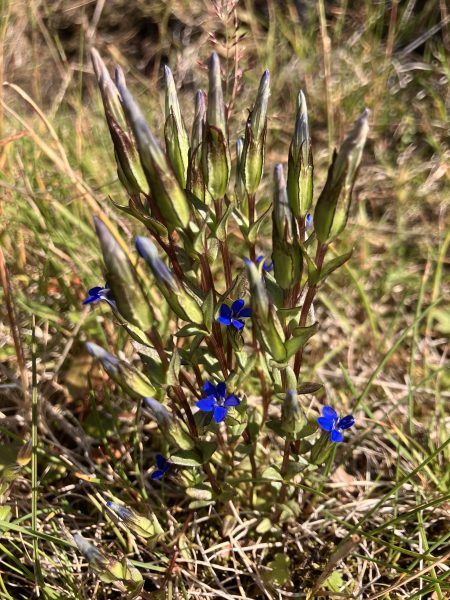
It was easy to succumb to the steep downward slope and just sit on the grit of the ground. Small blooms of true blue drew me further down, face to gravel and greens. I called out to my son Alder, to show him my find, but the pervasive roar of falling water drowned my voice. He was far ahead of me anyway, already immersed in the mist of the falls.
I guessed the flower to be a gentian by the cobalt blue color and chalice shape. Later, iNaturalist confirmed it to be Alpine gentian (Gentiana nivalis), native to a limited range in Greenland, Iceland, Norway, the Alps, and parts of the UK. It was the only one I’d seen over the five miles we’d hiked so far. I was in awe of it’s tiny majesty.
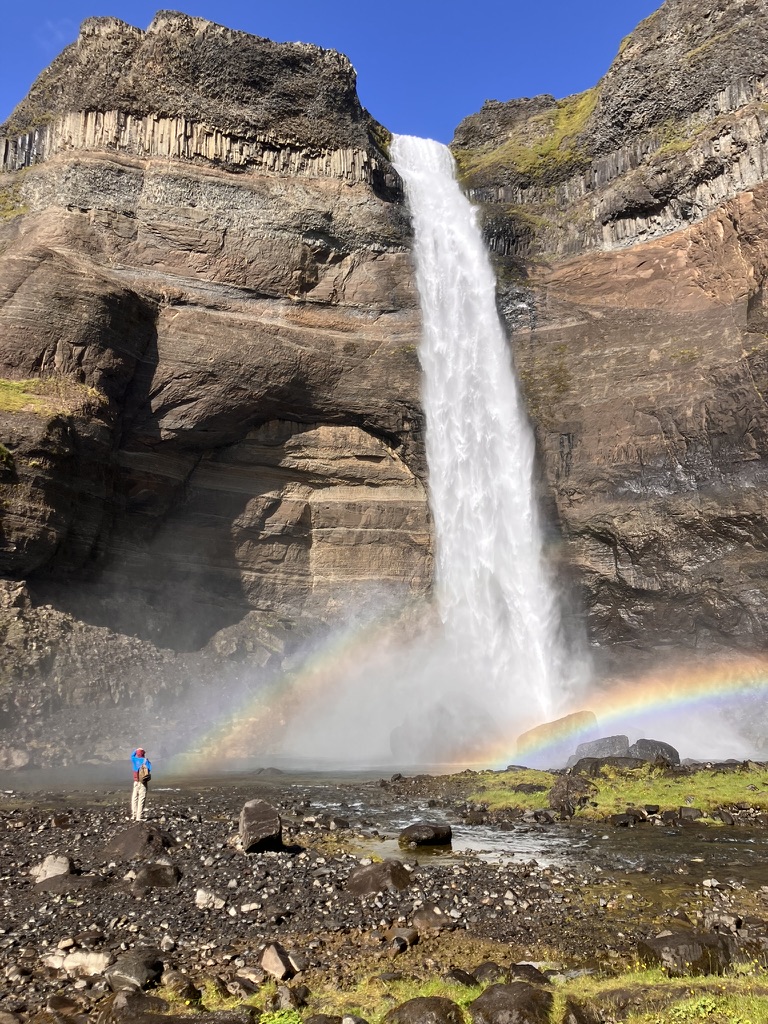
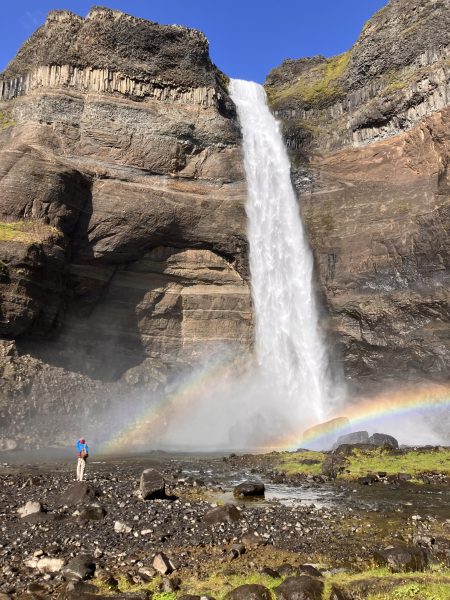
And then, I raised my gaze to the rainbow-fronted presence of Haifoss, one of the tallest waterfalls in Iceland at 400 feet, and I was floored once again, hands grasping rocks to steady the vertigo. Throughout our time in the land of fire and ice, Alder and I repeatedly commented on the simultaneous immensity and minutia of the natural beauties. Giants and fairies alike are at home in Iceland.

Cougars and bears, though, don’t live on the island nation. There are no large predators, no rattlesnakes, no poison oak even. Which meant our hike up the remote Þjórsárdalur valley to Haifoss felt unusually safe for how wild the setting was. Grazing sheep ran away from us, wooly bottoms jiggling in their hasty retreat. Our only other companions were the clear, gurgling streams flowing down side canyons and all the small, carpeting plants: edible black crowberry, tough domes of moss campion, frost-colored lichens, tough mosses, and woolly willow buns that looked like large garden sage.
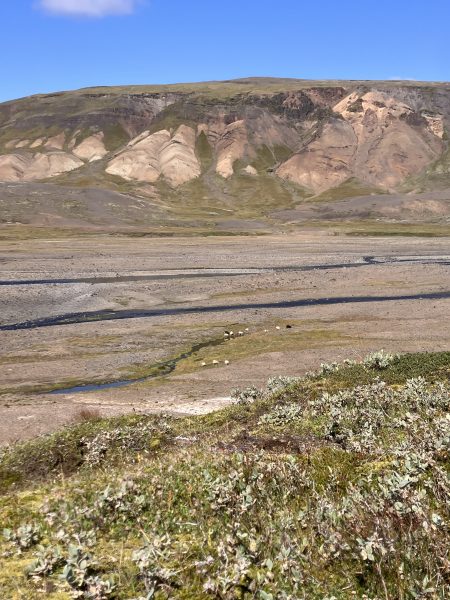
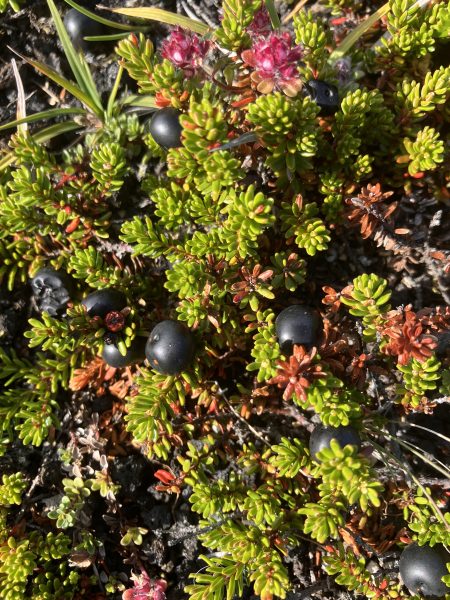

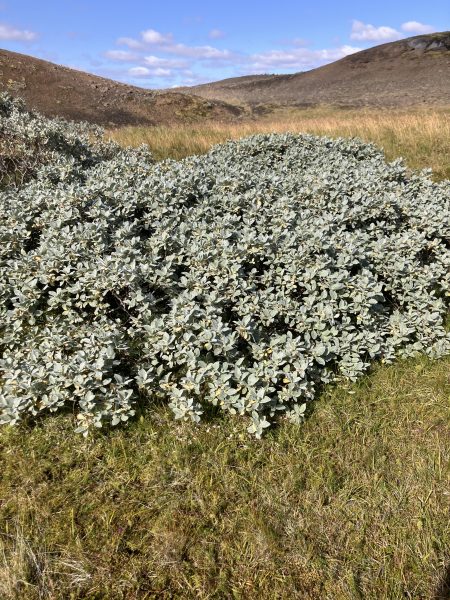
The peace and solitude was welcome. Other, more accessible destinations in Iceland are overrun with tourists sporting stiff, new hiking boots and color-block, quick-dry, trekking pants. The first waterfall we visited on our trip required us to wait in line for the chance to snap a photo before moving on with the masses to the next site along the path. We’d veered away from the crowd onto a side trail where Alder lifted yellow-striped caterpillars from underfoot and I took photos of angelica. Back at the car, sandwiched in between a tourist bus and the ubiquitous Dacia rental car, we determined to do our research, to avoid the crowds, and to find the unique heart of the place.
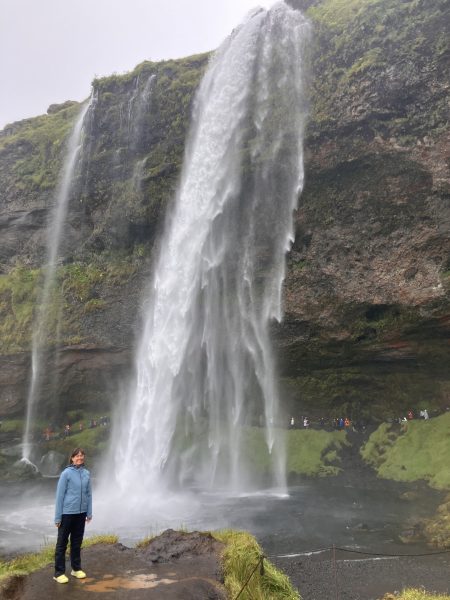
There’s an initial sameness that strikes me when I travel, a surprising similarity, a flattening of the diversity you’d expect after traveling so far from home. The brands of clothes worn by travelers and locals alike shout their well-known logos across chests and on packs: Nike, Vans, Fjällräven. Supermarket foods too, are strangely familiar, like the Schär gluten free bread, the same as we eat at home.
On this trip, I also noticed the globalized sameness in the vegetation. Weedy yellow dock (Rumex crispus), with it’s dark seedheads rising above tawny grasses is common in Oregon fields as well as in Iceland. I saw yellow dock on our first stop, the Netherlands, too. Yarrow (Achillea millefolium), one of my best beloved Oregon natives, thrives in both of these far-flung countries. Lady’s mantle (Alchemilla mollis), frequently found in US gardens and nurseries, grows in wild sweeps in Iceland, lushly leaved with a chartreuse foam of flowers. They looked so at home that I wondered if they were an Icelandic native. But, no, they’re a garden escapee, originally hailing from south-eastern Europe and south-western Asia. In the nearby Faroe Islands, lady’s mantle has reached “invasive” status with regular community pulling events to curb it’s spread. Yellow dock, I learned, is actually native to Europe, but invasive in north America. Whereas yarrow’s native range extends across the temperate regions of the entire Northern Hemisphere.
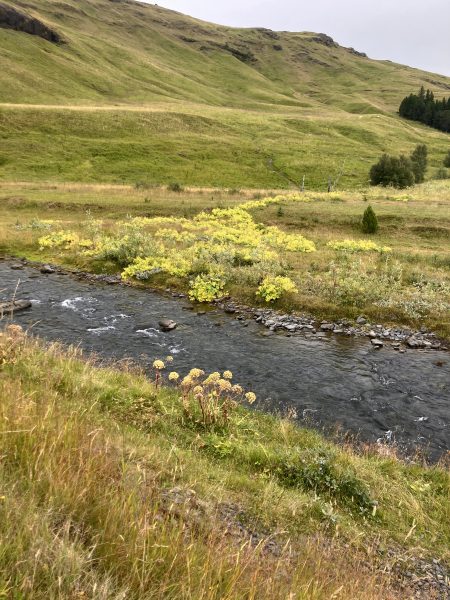

Lupine, with their familiar palmately compound leaves, was mostly past bloom by the time of our visit in mid-August. Vast swathes of them line the roadways throughout Iceland. Their peak May bloom is promoted in tourism materials as a quintessential Icelandic experience, even though the plants are not native. They’re Nootka lupine (Lupinus nootkatensis) brought in from Alaska in the 1940’s to combat erosion. Like so many well-intentioned introductions, the lupine has made itself all too comfortable in Iceland and now overtakes natural flora, threatening biodiversity.

The Nootka lupine is classified in Iceland as “naturalized”, rather than “invasive”. This is a fine line and a topic of ongoing debate. For a plant to be “naturalized” means that a species introduced from somewhere else has acclimated to such an extent to their new home that they persist without cultivation. To be a naturalized US Citizen means that a person born elsewhere has undergone a legal process which includes proving their “good moral character” in order to become a citizen. This word is nuanced, complicated like so much of our globalized existence. Applied to plants or to people, it confers an acceptance, a welcoming even. The harsher term “invasive” carries overtones of xenophobia and fear. How do we distinguish between a species that has simply adapted to a new place and one that may be causing harm?
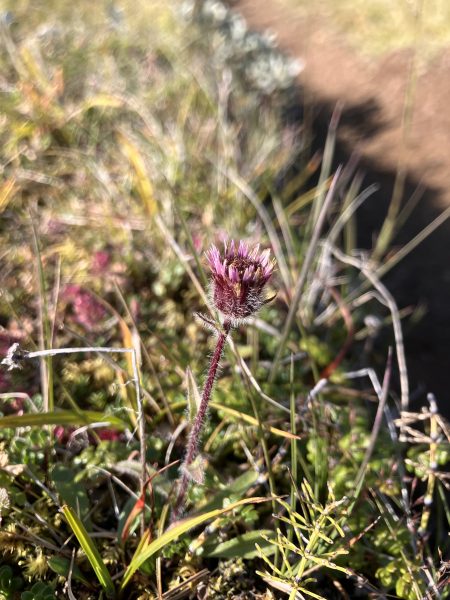
Our hike from the Stöng Viking-era farmstead, an archeological site, up the valley to Haifoss greeted us with a tapestry of truly native wildflowers. We had to get away from the crowds with their global languages and global weeds to find the authentic place, rich in small-scale vegetation hugging volcanic soils. Here we met Iceland and her original fairies and flora. Besides the singular Alpine gentian I ogled near the falls, we also encountered a few rare Alpine fleabane (Erigeron borealis), kin to the Willamette Valley’s showy fleabane (Erigeron speciosus). This little daisy grows only in Iceland and Norway. The tiny petals stood spiky and upright, not yet fully open. I wondered at their resilience on such wind-swept slopes.
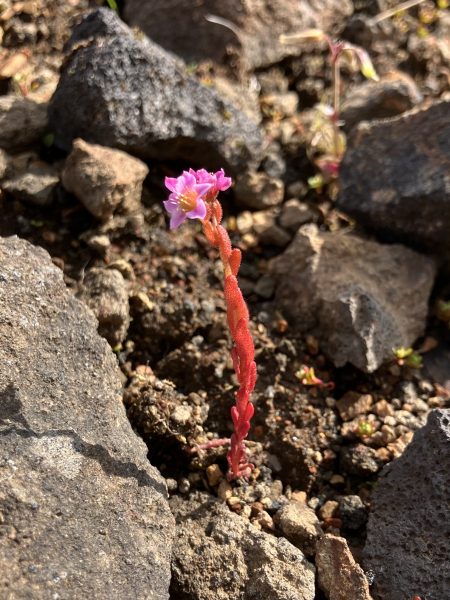
Alder pointed out a tiny pink flower that I’d overlooked. Rising from dark, volcanic gravel, moist from a subsurface seep, the pattern of starry petals pointed with gold pollen was familiar, but I couldn’t place it. Surprisingly, I learned that this Icelandic native is called hairy or purple stonecrop, (Sedum villosum). Rather than the mat of succulent leaves that I’m used to seeing in Sedums, this dainty lass grows singular upright stems, whorled with leaves smaller than the blooms. And, it prefers damp ground!
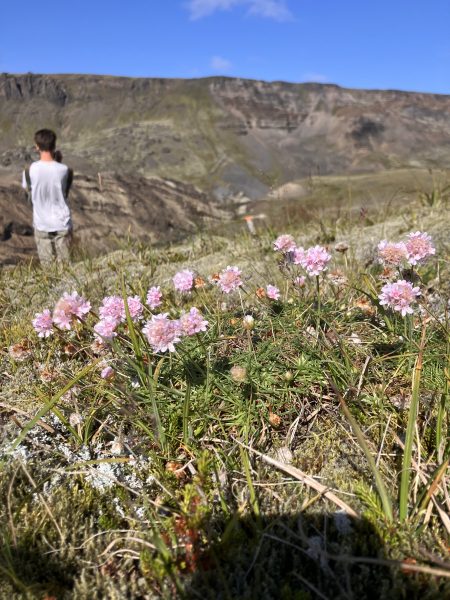
Using iNaturalist, I studied the observation maps and native ranges of the plants I met. It was fascinating to see how many are widespread throughout the Northern Hemisphere. Sea thrift (Armeria maritima) common on the Oregon coast with dark magenta bobbles rising from mossy green domes, is one of these widespread darlings. Though I was surprised to see a friend from home in the Icelandic highlands, I learned that sea thrift’s native range is circumpolar. They’re found all the way around the arctic regions in dry, sandy, saline soils including the west coast of the US, and the Northeast, into Canada, Alaska, Greenland, Iceland, Europe, and even Russia! Twelve subspecies have been described, which I guess is to be expected when a plant lives in such far and wide locales. The sea thrift we met in Iceland bloomed in a soft pink hue, unlike the dark flowers of home, or even the white form found in nurseries.
The eleven mile hike to Haifoss and back was physically the hardest of many long walks on our travels. Alder said with sincerity that it was a religious experience. I’ve never heard him say anything like that before, but I immediately agreed with the sentiment. The solitude, wildness, tiny wildflowers, and massive waterfalls are all deeply effecting, especially paired with the bodily effort of the hike. I’ll call on the images in my mind’s eye in times of stress. I think this is why we travel, or even why we step outdoors at home—for these soulful impressions that connect us to something bigger.
Back at home in the southern Willamette Valley of Oregon, I savor the things that make this place unique, that define it as place unlike others around the globe. From our massive trees, which I’ve learned not to take for granted after the treeless expanses of the Netherlands and Iceland, to our small wildflowers, Oregon’s native plants look even more special to me after traveling. I have a new appreciation for those that are endemic to the valley. As opposed to widespread natives like yarrow and sea thrift, endemic species are those that grow only in a very limited range.
Aaron diligently watered my little nursery while Alder and I were away. Still jet-lagged, I greeted the first blooms emerging from the fine leaves of the potted Hall’s aster (Symphyotrichum hallii). I’d started these from seeds nearly a year ago. This smallest of our Pacific Northwest asters is endemic to the Willamette Valley where it’s wild populations are scarce. Cultivating it in home gardens is a celebration of place, an elevation of biodiversity, and a significant act of conservation. But, really, they’re just fun to grow because they’re different!

The most floriferous Hall’s aster from my nursery now sits on my patio table where the soft purple petals catch the low-angled light of early fall evenings. It strikes me as the the most fairy flower of the season. There’s a glamour of magic to their daintiness. No, it’s not bold and showy like the ‘Hella Lacey’ aster growing in the garden nearby with calamint and black and blue salvia. But, yes, it does attract all kinds of fairy-winged insects. And, even more significantly, it grounds me to this specific place in the Willamette Valley of Oregon. I know I’m firmly back home.