
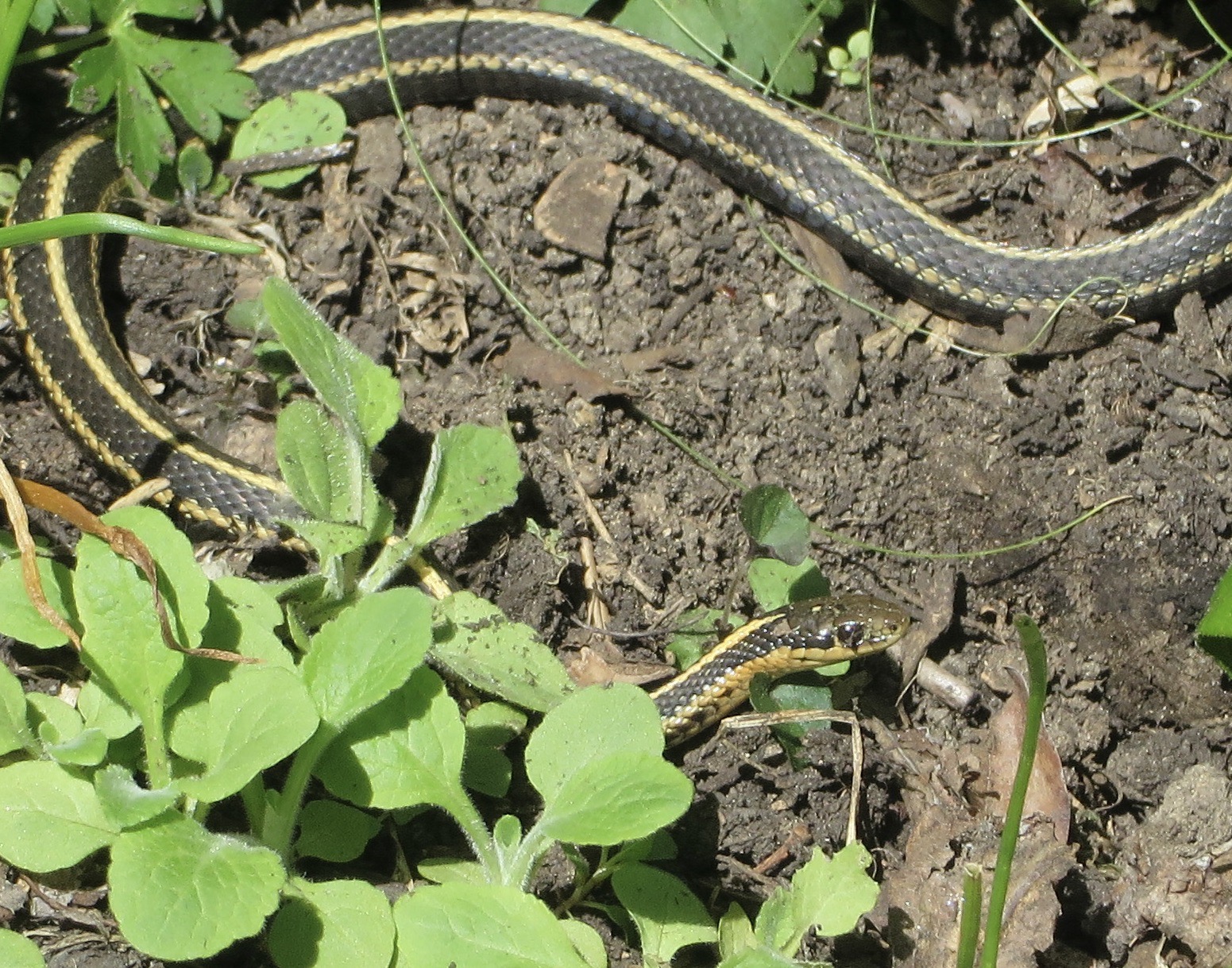
To look into the face of an other—a small face, smaller than your own, eyes clear and soulful, two nose holes through which oxygen passes just like through your two nose holes, and the line of a mouth that could be said to smile, covered in a skin so different than yours, scaled and varicolored—is to step outside the narrowness of your busy mind, the dailiness of task-oriented hustle, and the unrelenting horrors of national news.
As much as gardening is about plants and the bending and tending of them, it’s also about encounters with small creatures that interrupt, that expand, that strike awe and appreciation.
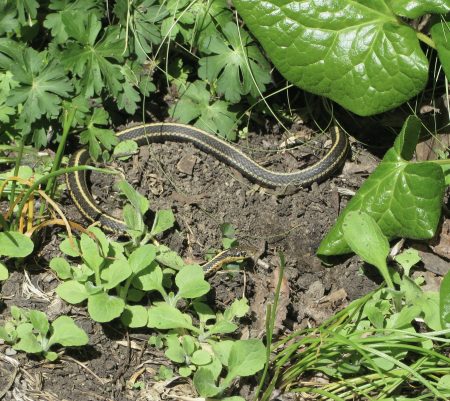
When I come upon a garter snake in the garden, there’s nothing to do but to hold completely still and watch. Then, to possibly slip my phone out for a picture that rarely captures what the eye holds, but is hard to resist attempting anyway.
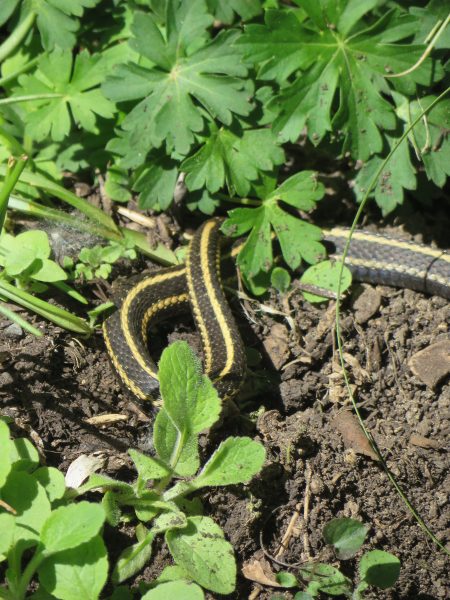
It feels lucky, an auspicious sign, to sight a garter snake while hefting a debris bucket in one hand, grasping pruners in the other. Even more so now that we’ve entered the Chinese New Year of the Yin Green Snake.
This year is said to carry young adult energy, the fire energy of instincts and intuition. Picture a snake resting still in the warm sun, ready to strike quickly when needed. Brimming with ideas and the will to get things done, partnering with snake energy in 2025 could bring to life your most vibrant garden yet.
I’m embarrassed to admit that I thought garter snakes were called gardener snakes well passed childhood. But I’ve learned that I’m not the only one. They deserve this alternate name for the friendly roles they play in the ecology of our cultivated green grounds. Dining on grasshoppers, snails, slugs, grubs, a variety of insects, and even mice, garter snakes keep the garden in balance. “Pests” become “dinner” for your guests when this ally is made welcome, re-framing the whole notion of pest control.
Peering from a crack in the low rock wall, two dark eyes and a flickering red thread of a tongue investigate the patio near my seat. Is it safe to emerge and bask on the radiant rock face? Or are the feral cats slinking and stalking? I shew the hunters away with a pssst, step aside, and wait to see what the snake decides.
Welcoming garter snakes in the garden doesn’t require much. A pile of rocks offers shelter and warmth for their cold-blooded bodies. Stones can be neatly set with intentional crevices, or jumbled and raw—snakes aren’t aesthetically particular. Logs, old boards or other material can be equally homey for our reptilian allies. The warmth of a mouldering compost pile covered with a sheet of black plastic was a favorite spot for garters in one of the earliest gardens I worked. We learned to tap a gentle hello before lifting their roof!
Some garter snakes can swim and all appreciate a garden water source like a small pond, fountain, or even a shallow dish where irrigation water collects.
Of course, you’ll want to avoid using pesticides if you like snakes even a little bit. Do I even need to mention this to you habitat-minded gardeners? You must already know it’s so much better to let the snakes, birds, and other lively agents do their job.
There’s a variety of garter snakes in the genus Thamnophis that may show up in your garden. In Oregon, these include the western terrestrial garter snake (Thamnophis elegans), common garter snake (T. sirtalis), the northwestern garter snake (T. ordinoides) and all their diversity of subspecies.
It can be a fun challenge to identify who comes to visit. There’s so much variation even within the same species. You’ll recognize them in general by their slender bodies and signature stripe running down their backs. The stripe can be yellow, light orange, or white. Some will have fancy checkered side bodies or a coordinating side stripe.
You may only be alerted to the presence of these shy creatures by what they leave behind. A shed skin found lying loosely on the fescues is a treasure worthy of bringing in to your nature table.
Recently, I saw my dog Leela pouncing nervously at our living room floor. Forward and quickly back again she appeared to be attacking something without the full confidence of aggression she’d give to a gopher in the field. The lingering scent and airborne lift of a garter snake skin, fallen from the mantle above, riled her fear as much as her curiosity.
I find this ability to shed a skin that’s too tight and no longer serving its purpose a refreshing analogy for how we can approach the ever-changing evolution of our gardens. After all, gardens are made more diverse, complex, and compelling through disturbance. By that I mean, gardening is the discerning act of removal as much as addition.
Go ahead and edit. Let go of the struggling lavender that’s now too shaded by the maturing hedge. Release the lacewing infested azalea. Shed the plant that constricts your heart every time you come upon its sad struggle. It no longer fits. And that’s okay. Give it to your dog to play with. Compost it. Chuck it into the log pile to create more shelter for friendly creatures. Follow your snake-like instincts to strike at the opportunity to change.
I love this snake tale Leslie! And I am so glad for all the habitat you and Aaron created in my garden for the snakes and so many other creatures. Once a great blue heron visited the pond you designed so well that I’ve never lost a koi to a predator. The heron decided it wasn’t worth the effort to even try. The raccoons like to wash in the waterfall but don’t dare go fishing with the.vertical drop into the pool. Thank you for the happiness and beauty the space continues to bring, season after season.